
Topsoil production is one of the most profitable sectors in bulk material supply, site development, and compost manufacturing. Raw excavated dirt purchased or stockpiled at $5 to $10 per cubic yard can be processed into certified, screened topsoil selling for $25 to $45 per cubic yard.
However, realizing these profit margins requires a commercial topsoil screener capable of delivering consistent hourly throughput, low fuel consumption, and minimal maintenance downtime. This commercial guide breaks down throughput calculations, equipment sizing economics, and cost-per-yard modeling.
1. Commercial Throughput Calculation: Yards per Hour vs. Metric Tons
Estimating real-world screening capacity requires understanding raw material density and bulk volume expansion:
- Dry Loam & Sandy Topsoil: Bulk density of 1.25 t/m³ (approx. 0.95 tons per cubic yard). High flowability allows machines to operate at 90%–100% rated capacity.
- Damp Loam / Topsoil with Compost (18%–22% moisture): Bulk density of 1.45 – 1.60 t/m³ (approx. 1.15 tons per cubic yard). Material cohesion reduces effective screening area; requires 15%–20% capacity derating.
- Excavated Fill with Heavy Clay & Boulders: Bulk density exceeding 1.75 t/m³. Requires heavy-duty hopper grizzly bars and high-torque drum drive to prevent drive stalling.
Quick Capacity Reference:
Hourly Output (Yards)=Bulk Density (t/m³)Throughput (Metric Tons)×1.308
A 70 ton/hour machine (such as the SENKE MTS1230) operating in damp topsoil (1.45 t/m³) delivers approximately 63 cubic yards per hour of clean finished product.
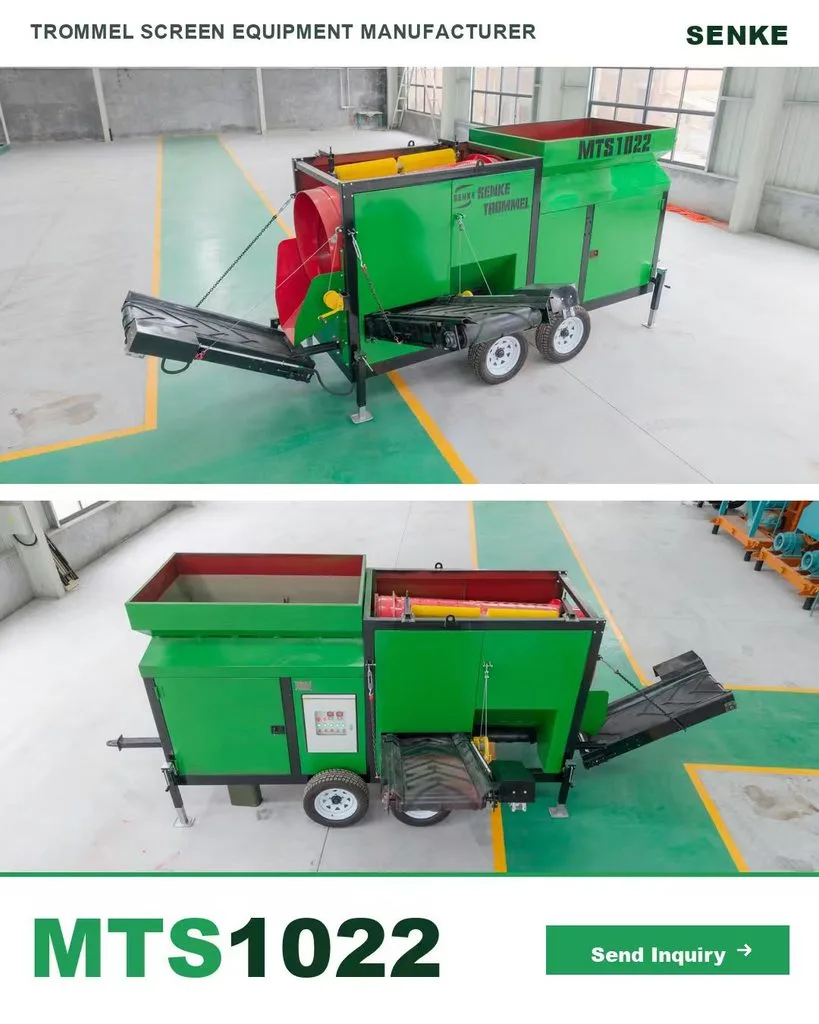
2. Model Sizing Matrix: Commercial Topsoil Screening Equipment
| Commercial Category | SENKE MTS0818 (Compact Commercial) | SENKE MTS1230 (Contractor Grade) | SENKE MTS1550 / TS1530 (Industrial Heavy Duty) |
|---|---|---|---|
| Target Daily Output | 100 – 250 Yards / Day | 350 – 700 Yards / Day | 800 – 1,500+ Yards / Day |
| Ideal Operations | Tree nurseries, small landscaping yards, rental fleets | General excavation contractors, compost facilities | Regional aggregate quarries, municipal recycling centers |
| Drum Dimensions | 800 mm Dia. × 1,800 mm L | 1,200 mm Dia. × 3,000 mm L | 1,500 mm Dia. × 5,000 mm L |
| Drive System | Diesel-Hydraulic (18 kW) / Electric | Diesel-Hydraulic (38 kW) / Dual Hybrid | Diesel Turbo (55–75 kW) / Dual Hybrid |
| Fuel / Power Consumption | ~3.8 – 4.5 Liters/hour | ~6.5 – 8.0 Liters/hour | ~10.5 – 13.0 Liters/hour (or 37 kWh) |
| Mobility | Single-Axle Highway Towable | Dual-Axle Towable or Tracked | Heavy Crawler Tracked / Multi-Axle |
| Estimated Equipment Payback | 3 to 5 Months | 4 to 6 Months | 6 to 9 Months |
3. Financial Breakdown: Cost-Per-Yard and ROI Analysis
Investing in a commercial topsoil screener shifts external disposal and buying costs into high-margin revenue streams. Consider the operational cost model below based on a mid-sized contractor processing 500 cubic yards per day with a SENKE MTS1230:
Operating Cost Model (Per 500-Yard Day):
- Fuel Consumption: 8 hours × 7.0 L/h × $1.10/L = $61.60
- Operator & Loader Share: 8 hours @ $35/h = $280.00
- Wear Parts & Maintenance Reserve: $0.25 per yard = $125.00
- Total Daily Operating Cost: $466.60 ($0.93 per screened yard)
Profit Margin Generation:
- Raw Material / Hauling In Cost: $6.00 / yard
- Processing Cost: $0.93 / yard
- Total In-Pile Cost: $6.93 / yard
- Wholesale Selling Price (Screened Topsoil): $28.00 / yard
- Net Profit Per Yard: $21.07
- Daily Gross Profit (500 Yards): $10,535.00
At this production scale, an initial equipment investment is fully amortized within 30 to 45 active production days.
4. Key Engineering Features to Demand from a Manufacturer
When procuring commercial-grade topsoil screeners, verify these structural and hydraulic specifications:
- Direct Hydraulic Drum Drive: Avoid chain or belt drum drives that slip when wet dirt builds up. Direct heavy-duty rubber trunnion friction drives or heavy ring-gear drives provide reliable torque transmission.
- Radio Remote Tipping Grid: Allows the loader operator to clear oversize rocks from the feed hopper without leaving the cab, saving 20–30 minutes of lost production per shift.
- Dual-Power Hybrid Option: Combining an onboard diesel generator with electric plug-in motors gives operators the flexibility to run on low-cost grid electricity in fixed yards or switch to diesel on remote job sites.
5. Frequently Asked Questions (FAQ)
Q1: Is a tracked mobile screener worth the extra investment over a wheeled towable unit?
A: If you operate on soft, muddy terrain or frequently reposition the screener along long soil stockpiles, a tracked screener eliminates the need for towing trucks or support tractors, increasing site efficiency by up to 25%.
Q2: What is the typical lifespan of a woven wire topsoil screen panel?
A: In standard sandy loam and compost, high-tensile carbon steel screen panels last between 800 and 1,500 operating hours. For highly abrasive rocky fill, manganese steel perforated drum plates extend panel life to over 3,000 hours.
Q3: How do Henan Senke screeners maintain compliance with international transport regulations?
A: All SENKE mobile screeners fold hydraulically into compact road-legal transport dimensions (under 2.55 m width and 3.8 m height), allowing quick mobilization on standard low-bed trailers without oversized permits.